
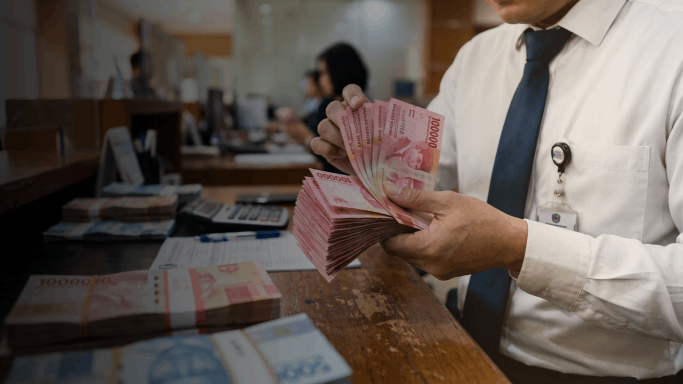
Tax revenue reached IDR 1,409 trillion as of August 31, 2026, equivalent to 59.8% of the IDR 2,357.7 trillion target set in the 2026 State Budget (APBN). The realization marked a 24.1% increase from the same period last year.
The growth in tax revenue was mainly driven by value-added tax (VAT) and sales tax on luxury goods sales tax, as well as oil and gas income tax. Oil and gas income tax recorded the highest growth, rising 63.8% year on year.
Finance Minister Suahasil Nazara said tax revenue had reached IDR 1,409 trillion through the end of August, growing 24.1%.
“Tax revenue stood at IDR 1,409 trillion, growing 24.1%,” Suahasil said at a press conference on the September 2026 edition of the APBN KiTa report at the Finance Ministry office in Jakarta on Friday (Sept. 18, 2026).
VAT and Luxury Goods Sales Tax Grow 38.9%
VAT and luxury goods sales tax revenue reached IDR 591.5 trillion through August 2026, representing 59.4% of the target and growing 38.9% year on year.
According to Suahasil, the increase in revenue from the two taxes was linked to domestic consumption and household purchasing power.
Meanwhile, non-oil and gas income tax revenue stood at IDR 722.2 trillion, or 62.6% of the target. The figure grew 16.6% from the same period last year.
The growth in non-oil and gas income tax was partly driven by economic activity and improvements in tax administration.
Oil and Gas Income Tax Grows 63.8%
Oil and gas income tax revenue reached IDR 39 trillion through the end of August 2026, equivalent to 70.6% of the target and up 63.8% year on year.
Suahasil said global oil and gas prices were among the factors affecting tax revenue from the sector. Higher oil and gas prices can boost companies’ revenues, potentially increasing their tax payments.
“If global oil and gas prices rise, companies’ revenues will increase, and they may pay higher taxes. That is why growth reached 63.8%. It does not happen instantly—when prices rise, tax payments do not immediately increase. But we can still track the trend,” Suahasil explained.
In addition to the three tax groups, revenue from land and building tax (L&B Tax) and other taxes reached IDR 56.4 trillion, equivalent to 36.8% of the 2026 State Budget target.
State Revenue Grows 25.4%
Overall, state revenue reached IDR 2,055.6 trillion as of August 31, 2026, or 65.2% of the IDR 3,153.6 trillion target set in the State Budget.
Compared with the same period last year, state revenue grew 25.4%. In August 2025, state revenue stood at IDR 1,639 trillion.
Outside tax revenue, the government recorded non-tax state revenue (PNBP) of IDR 435.1 trillion, or 94.8% of the target. PNBP grew 41.7% year on year.
Meanwhile, total tax and customs revenue reached IDR 1,619.3 trillion, or 60.1% of the target, marking 21.7% year-on-year growth.
Tax and customs revenue consisted of IDR 1,409 trillion in tax revenue and IDR 210.2 trillion in customs and excise revenue. Customs and excise revenue had reached 62.6% of the target, growing 7.8% year on year.
State Budget Records IDR 240.1 Trillion Deficit
On the expenditure side, the government had spent IDR 2,295.7 trillion, or 59.7% of the IDR 3,842.7 trillion allocation in the 2026 State Budget. State spending grew 17.1% from the same period last year. Central government spending reached IDR 1,791.5 trillion, or 56.9% of the allocation, growing 29% year on year.
Ministry and agency spending reached IDR 912.4 trillion, or 60.4% of the allocation, growing 33%. Meanwhile, non-ministry and agency spending stood at IDR 879.1 trillion, or 53.6% of the allocation, up 25.1%. Realized transfers to regions stood at IDR 504.3 trillion, or 72.8% of the allocation. The figure declined 11.8% year on year.
With revenue of IDR 2,055.6 trillion and expenditure of IDR 2,295.7 trillion, the State Budget recorded a deficit of IDR 240.1 trillion through the end of August, equivalent to 0.93% of gross domestic product (GDP). Despite the deficit, the primary balance remained in surplus at IDR 154 trillion. Suahasil said the figure indicated that State Budget implementation through August remained in line with the government’s plans.
“Through the end of August, State Budget performance remained strong, with a positive primary balance and a deficit within manageable limits. This means the State Budget is relatively on track,” Suahasil said.
Also Read:
Tax Refunds Are a Right, Not a Fiscal Favor
What Is Tax in Indonesia?
Breaking Down the Article 21 Withholding Tax Provisions
