
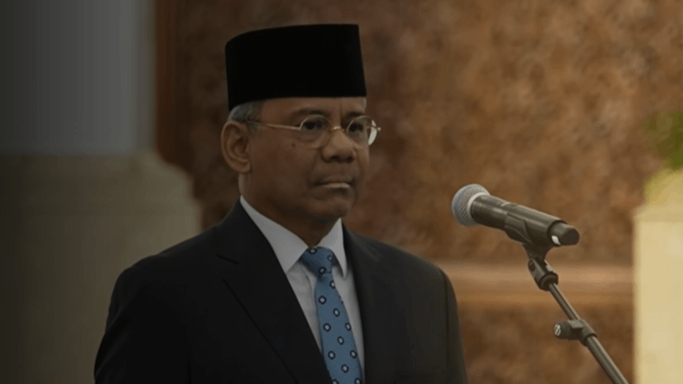
Suahasil Nazara was officially sworn in as finance minister on Monday (Sept. 14, 2026), replacing Purbaya Yudhi Sadewa. Following his inauguration, Suahasil assured that the state budget deficit would remain below 3%.
“The deficit will remain below 3%,” Suahasil told reporters after the inauguration ceremony on Monday (Sept. 14, 2026).
Suahasil said President Prabowo Subianto had instructed him to maintain the soundness and credibility of state finances. The state budget, he said, must support the implementation of the government’s priority programs.
“The state budget, as part of state finances, must be able to support the government’s priority programs. Therefore, the state budget must remain sound,” he said.
Suahasil also emphasized that the government would maintain the credibility and reliability of the state budget. He said fiscal policy must support economic growth while maintaining Indonesia’s economic stability.
“I will continue to implement a credible state budget, maintain credible public communication, and ensure that the state budget supports the government’s priority programs,” he said.
Regarding the change in finance minister, Suahasil described the transition as a continuation of existing policies. He said he had been part of the Ministry of Finance and would therefore continue the work already underway.
“In my view, this is not a change; it is a continuation,” Suahasil said.
He said the transition with the previous finance minister would be coordinated accordingly. Following his inauguration, Suahasil will return to the Ministry of Finance to continue the ministry’s work.
“The transition must certainly be well coordinated, and after this I will return to the Ministry of Finance. We will continue the ministry’s work as usual,” he said.
Suahasil also confirmed that budget efficiency measures would continue. However, he stressed that efficiency was not simply about cutting spending.
“Efficiency is not merely about cutting spending,” he said.
According to Suahasil, efficiency means using available budget resources to maximize outputs and deliver benefits to the public. Regarding changes within the Ministry of Finance, including in the customs and excise and taxation sectors, Suahasil said the government would review existing decisions and policies before determining follow-up measures.
As for Purbaya’s position after leaving the post of finance minister, Suahasil said the question should be directed to Purbaya himself.
Track Record at the Ministry of Finance
President Prabowo Subianto inaugurated Suahasil Nazara as finance minister in the Red and White Cabinet at the State Palace in Jakarta on Monday (Sept. 14, 2026). Suahasil replaces Purbaya Yudhi Sadewa, who had served as finance minister since Sept. 8, 2025.
The inauguration was based on Presidential Decree No. 97P of 2026 concerning the dismissal and appointment of the finance minister of the Red and White Cabinet for the remainder of the 2024-2029 term. Suahasil is the third finance minister under the Prabowo administration, after Sri Mulyani Indrawati and Purbaya Yudhi Sadewa.
Suahasil has extensive experience at the Ministry of Finance. Before being appointed minister, he had served as deputy finance minister since Oct. 25, 2019. He previously served as head of the Fiscal Policy Agency (BKF) from Oct. 31, 2016, after serving as acting head of the agency since February 2015.
Suahasil was involved in drafting the Law on Harmonization of Tax Regulations (UU HPP) and the Law on Financial Relations between the Central Government and Regional Governments (UU HKPD). His fiscal policy priorities included increasing the tax ratio and broadening the tax base. The government also promoted the implementation of the Core Tax Administration System (CTAS) in 2026 to improve tax administration and revenue collection.
Under the macroeconomic framework of the 2027 Draft State Budget (RAPBN), Suahasil designed a budget framework targeting 6% economic growth and a fiscal deficit of 2.4% of gross domestic product (GDP).
He also promoted policy coordination through the Financial System Stability Committee (KSSK), together with Bank Indonesia, the Financial Services Authority (OJK), and the Indonesia Deposit Insurance Corporation (LPS), as well as coordination with the Daya Anagata Nusantara Investment Management Agency (Danantara).
Suahasil earned a bachelor’s degree in economics from the Faculty of Economics and Business at the University of Indonesia (FEB UI) in 1994. He subsequently earned a Master of Science (M.Sc.) degree from Cornell University in 1997 and a Doctor of Philosophy (Ph.D.) degree from the University of Illinois at Urbana-Champaign in 2003.
In 2009, Suahasil was inaugurated as a professor of economics at FEB UI. His career also includes serving as head of the FEB UI Demographic Institute from 2005 to 2008, a member of the finance minister’s fiscal decentralization advisory team from 2009 to 2011, and a member of the National Economic Committee from 2013 to 2014. Suahasil also previously served as deputy president commissioner of state-owned electricity company PT PLN (Persero).
Also Read:
Tax Refunds Are a Right, Not a Fiscal Favor
What Is Tax in Indonesia?
Breaking Down the Article 21 Withholding Tax Provisions
