
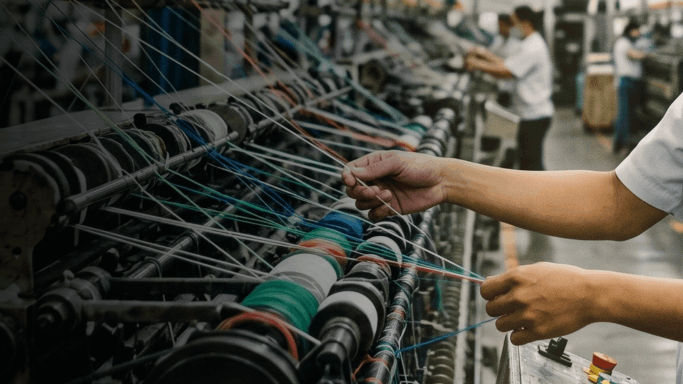
The government is reviewing value-added tax (VAT) provisions related to the use of fixed-term contract workers (PKWT) in the textile and garment sector.
Coordinating Minister for Economic Affairs Airlangga Hartarto said the review takes into account the characteristics of the textile and garment industry, which requires workforce flexibility. Labor demand can rise or fall depending on market conditions, particularly when companies receive seasonal orders.
“The textile and garment industry needs flexibility in employing workers, particularly fixed-term workers, especially in handling orders for four seasons, where demand varies from one season to another,” Airlangga said at the Presidential Palace Complex in Jakarta on Tuesday (Sept. 22, 2026).
The government is also looking at similar arrangements in other countries as part of its consideration, Airlangga said. He noted that outsourcing services that help meet workforce needs in several countries are not subject to the type of tax treatment currently being considered by the government.
Based on these considerations, the government believes adjustments to the regulations are needed to ensure the use of fixed-term workers remains aligned with industry needs. President Prabowo Subianto has also instructed the government to formulate appropriate VAT provisions for the arrangement.
“Earlier, the President also said that for VAT related to fixed-term workers, we would find the appropriate regulation,” Airlangga said.
Support for Textile Industry
The government’s discussions cover not only tax provisions related to labor. Tax policies and financing support for the textile and textile products industry are also under consideration, particularly for export-oriented companies.
President Prabowo has instructed banks under the Association of State-Owned Banks to reopen access to financing for the textile and textile products industry. One focus of the financing is the replacement of aging production machinery.
Chief Executive Officer of the Daya Anagata Nusantara Investment Management Agency (BPI Danantara) Rosan Roeslani said financing for machinery modernization is needed to improve the competitiveness of Indonesia’s textile and textile products industry.
“From our perspective, at Danantara and in terms of investment, together with Mr. Doni, we were instructed to address the banking side first. The industry was previously viewed by banks as a sunset industry, so access should be restored to ensure Himbara banks and other national banks provide financing, particularly to upgrade machinery that has become quite old,” Rosan said.
According to Rosan, modernizing production equipment is one of the industry’s needs to improve its ability to compete with textile products from other countries.
The government is also considering fiscal incentives for the textile and textile products sector, including tax holidays and tax allowances.
Meanwhile, Danantara will prepare an industrial area integrating the textile and textile products production chain from upstream to downstream. The integration is expected to improve production efficiency while encouraging the use of technology.
“Danantara will also prepare a special area to integrate the industry from upstream to downstream, making it more efficient through the proper use of technology and enabling our products to become more competitive,” Rosan said.
Pushes Industry Competitiveness
Strengthening the textile and textile products industry was among the issues discussed at a limited meeting chaired by President Prabowo with several ministers and government officials at the Presidential Palace in Jakarta on Tuesday (Sept. 22, 2026). Airlangga said the textile and textile products sector remains a government priority because of its contribution to the economy, employment, and national export performance.
The meeting covered several measures to strengthen the industry’s competitiveness, including tariff harmonization from upstream to downstream, easier access to raw materials, and tighter controls on imports considered disruptive to domestic industry. The government is also considering restructuring textile and textile products companies to create room for new investment while strengthening the industry’s working capital capacity.
Airlangga said the textile and textile products industry currently contributes around 0.97% to gross domestic product (GDP). The sector also employs around 4 million workers and generates approximately US$12 billion in exports.
Also Read:
Tax Refunds Are a Right, Not a Fiscal Favor
What Is Tax in Indonesia?
Breaking Down the Article 21 Withholding Tax Provisions
