
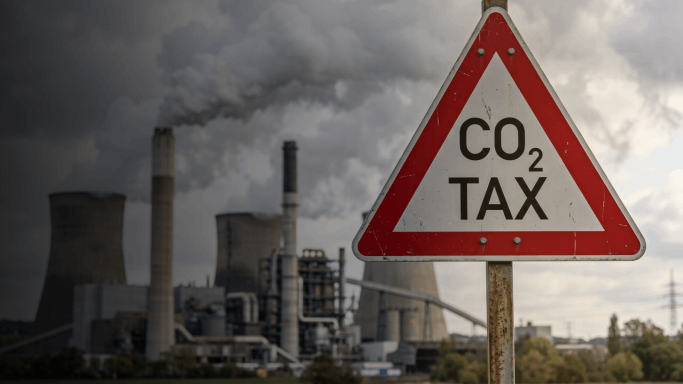
The Ministry of Finance (MoF) has yet to implement the carbon tax, despite the policy having a legal basis under Law No. 7 of 2021 on the Harmonization of Tax Regulations (HPP Law).
Hadi Setiawan, Senior Policy Analyst at the Ministry of Finance’s Directorate General of Economic and Fiscal Strategy (DJSEF), said the government has not yet set a timeline for implementing the carbon tax as it continues to assess economic conditions and the readiness of various sectors. He said the delay does not mean the government has abandoned the policy.
“This is only a delay. We will look for the right time to implement the carbon tax,” Hadi said at the International Taxation Seminar 2026 on Thursday (Sept. 24, 2026).
The HPP Law initially stipulated that the carbon tax would take effect on April 1, 2022. However, the government delayed its implementation, taking into account economic conditions, the readiness of businesses and the public, as well as developments in Indonesia’s carbon pricing policies.
Conditions in the energy sector are among the factors being considered. Indonesia still relies heavily on coal and fossil fuels for its energy supply. Under these conditions, carbon pricing could increase electricity generation costs and raise fossil fuel prices.
According to Hadi, higher energy costs could also affect the government budget by increasing the need for energy subsidies and compensation.
“Most of our electricity still comes from coal and fossil fuels. Therefore, carbon pricing will increase electricity generation costs and fossil fuel prices,” he said.
The impact would not be limited to fiscal considerations. If the energy and industrial sectors do not yet have adequate alternative energy sources or technologies, the additional costs could be passed on to consumers. This could push up energy prices as well as the prices of goods and services.
“If the energy and industrial sectors are not ready with alternatives, the costs will be passed on to the public. In other words, prices will be higher. This could then create broader social and economic pressures,” Hadi explained.
For now, the government has opted to strengthen the development of the carbon market. Hadi said market-based mechanisms, including the voluntary carbon market through IDX Carbon, provide greater flexibility in determining carbon prices than imposing a tax directly.
The development of the carbon market is expected to create a credible price signal while encouraging emissions reductions without placing excessive economic pressure on businesses and consumers.
Progress toward emissions reduction targets is also among the government’s considerations. Hadi said Indonesia’s emissions reduction in 2024 had exceeded the target set by the government.
Indonesia’s emissions reduction target stood at 31.89%, while actual reductions in 2024 exceeded 35%. The achievement is among the factors the government is considering in determining the need for and timing of carbon tax implementation.
However, this achievement does not mean the carbon tax will be set aside. The government will continue to monitor progress toward Indonesia’s Nationally Determined Contribution (NDC) target. If emissions reductions in subsequent periods fall short of the target, the carbon tax could again be considered as one of the policy instruments.
In designing the policy, the government will also take into account fairness, ease of implementation, and a gradual approach.
“We will implement the carbon tax based on at least three principles: fair, easy, and gradual,” Hadi said.
In addition to economic conditions and emissions performance, implementing a carbon tax requires several supporting systems. These include measurement, reporting, and verification (MRV) systems, a registry system, as well as the availability of alternative technologies and energy sources for the energy and industrial sectors.
The government has also regulated the use of carbon tax revenue. Under the HPP Law, the revenue may be allocated to support climate change mitigation and adaptation activities.
Also Read:
Tax Refunds Are a Right, Not a Fiscal Favor
What Is Tax in Indonesia?
Breaking Down the Article 21 Withholding Tax Provisions
