
As of now, 186 out of 416 regencies and cities have set their 2026 regency minimum wages (upah minimum kabupaten/UMK). According to the Ministry of Manpower's preliminary recap, the average UMK for 2026 stands at IDR 3.4 million per month. The highest minimum wage was recorded in Bekasi at IDR 5.9 million per month, while the lowest was in Banjarnegara at IDR 2.32 million per month.
The determination of both the UMK and the provincial minimum wage (upah minimum provinsi/UMP) takes into account several variables, including inflation, economic growth, and specific indices (alpha) that reflect labor’s contribution to regional economic growth. These parameters are regulated by Government Regulation Number 49 of 2025 concerning the Second Amendment to Government Regulation Number 36 of 2021 concerning Wages.
Minimum Wage Increases and Their Impact on Income Tax
With this new formulation, both the UMP and UMK are effectively guaranteed to increase annually in line with changes in the relevant variables. This contrasts with the non-taxable income threshold, which has remained unchanged since 2016. Consequently, over time, increases in minimum wages may be eroded by income tax.
By way of comparison, in 2016, the DKI Jakarta UMP was set at IDR 3.1 million per month under Governor Regulation Number 230 of 2015. During the same period, the non-taxable income threshold under Minister of Finance Regulation Number 101/PMK.010/2016 averaged IDR 4.5 million per month. Under these conditions, minimum-wage workers in DKI Jakarta were not subject to income tax, as their income remained below the non-taxable threshold.
This year, however, the DKI Jakarta Provincial Government, through Governor Decree Number 1142 of 2025, has set the 2026 UMP at IDR 5.7 million per month. If the non-taxable income threshold remains unchanged, minimum-wage earners in DKI Jakarta will begin to fall within the scope of Article 21 withholding tax.
Tax Pressure on the Middle Class
Middle-class workers face similar pressures. Since the amendment of the Income Tax Law in 2008, the individual income tax brackets have remained largely unchanged. Although the government introduced a 35% tax rate for individual taxpayers with annual incomes exceeding IDR 5 billion through the 2021 Harmonization of Tax Regulations Law, the lack of adjustments to the lower tax brackets has placed additional strain on the middle class.
Data from Statistics Indonesia indicate a significant rise in the share of household expenditure allocated to taxes among the middle class. In 2024, tax expenditures accounted for 4.53% of total middle-class spending, up sharply from 1.62% in 2014. Notably, this figure is now approaching that of the upper-income group, which stood at 4.83%.
Risk of Middle-Class Decline
If current trends persist, there is a real risk that portions of the middle class may slip into the aspiring middle class (AMC) category. According to Statistics Indonesia, the middle class plays a strategic role in sustaining economic growth, particularly through household consumption.
The AMC refers to individuals who are no longer classified as poor but have yet to achieve stable economic security. As a result, they remain vulnerable to downward mobility in the event of income shocks or economic disruptions.
Reformulating Article 21 Withholding Tax
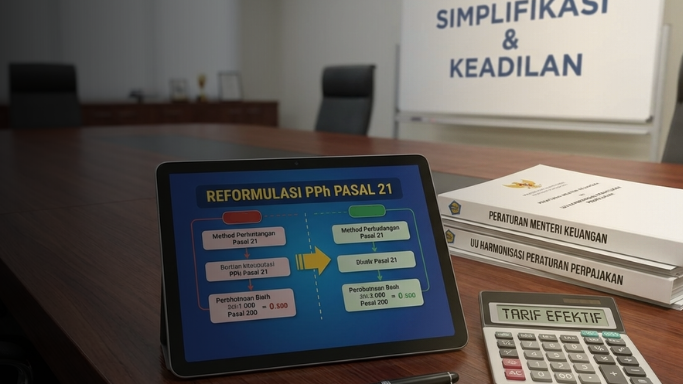
To address these challenges, a more inclusive reform of Article 21 withholding tax is necessary. One potential measure is to adjust the non-taxable income threshold to account for inflation, economic growth, and developments in the UMP and UMK. Such an adjustment would not only protect low-income workers from the dilution of minimum wages due to taxation but also bolster the economic resilience of the middle class.
Another possible measure is to revisit the individual income tax brackets. From an economic standpoint, adjusting these brackets could enhance the middle class’s capacity for household consumption. In microeconomic theory, lower income tax rates increase disposable income, allowing households greater flexibility in consumption decisions. This, in turn, can generate multiplier effects across industrial sectors and support overall economic growth.
However, both strategies will be fully effective only if they are accompanied by a reassessment of Article 21 withholding tax incentives for state officials. Currently, state officials benefit from government-borne Article 21 withholding tax, meaning that no tax is withheld from their income. This situation raises concerns about fairness, as the Income Tax Law explicitly states that income tax should be collected equitably. Inevitably, perceptions of inequality have emerged within society.
Accordingly, alongside adjustments to the non-taxable income threshold and individual income tax rates, the government should also reconsider the government-borne Article 21 withholding tax policy for state officials, particularly in light of ongoing economic pressures.
Also Read
https://ideatax.id/articles/article-26-withholding-tax-on-foreign-taxpayers
https://ideatax.id/articles/the-chart-of-accounts-for-coretax-reporting
https://ideatax.id/articles/per-19pj2025-beware-of-tax-invoice-access-deactivation
